+91 9999968096
 Photo Gallery
 Blog
Blog


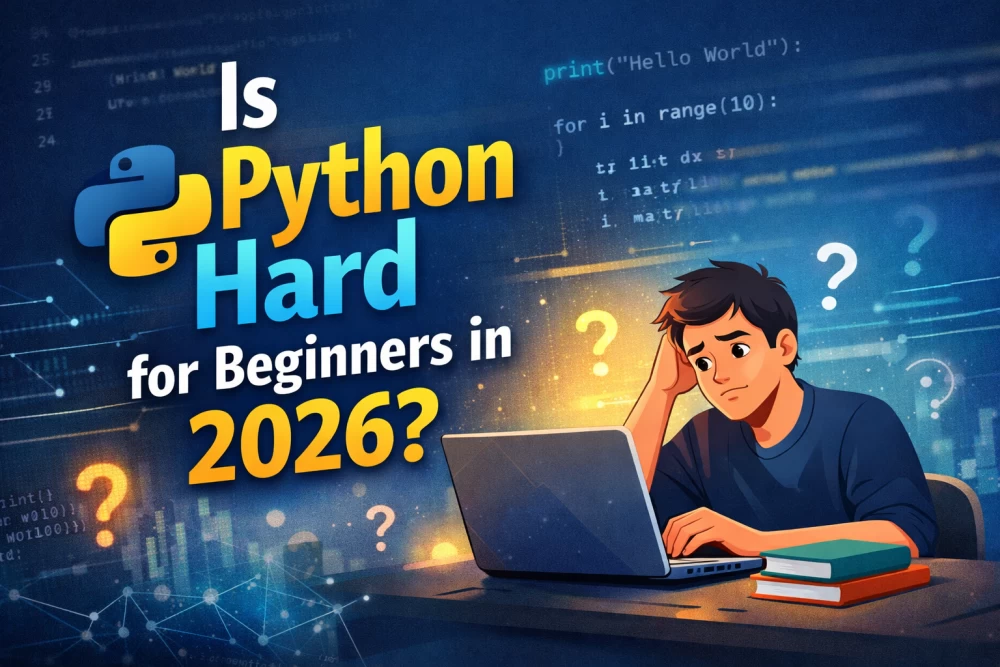
Table of Contents
- Why Python Still Matters in 2026
- The Good News: Syntax & Readability Make Python Easy to Start
- Common Challenges Beginners Actually Face
- 1. Thinking Like a Programmer Is Hard
- 2. Syntax Errors and Indentation Rules
- 3. Understanding Programming Concepts
- Beginners' Population: What Community Learning Says
- Will Python Be Harder as You Advance?
- Is Python Actually Easier Than Other Languages?
- Tools and Resources That Help Beginners in 2026
- Realistic Timeline to Become Proficient
- Should Beginners Still Learn Python in 2026?
- Tips That Make Python Easier to Learn
- 1. Start With Fundamentals
- 2. Build Small Projects
- 3. Learn to Debug
- 4. Use Structured Learning Paths
- 5. Engage With Community
- Related Guides
- Final Verdict: Is Python Hard for Beginners?
Python remains one of the most talked-about programming languages in the world today. In 2026, it still dominates the landscape of software development, data science, machine learning, automation, and more. But for beginners who have never written a line of code before, the question lingers: Is Python hard to learn?
In this article, we'll explore the truth — not a sales pitch — backed by research, community insights, and real learner experiences. We'll break it down in a practical way so you know what to expect, how to navigate early challenges, and whether Python is actually a good first language in 2026.
Why Python Still Matters in 2026
Before we talk about difficulty, it's worth understanding why Python is still worth learning:
Python continues to be one of the most popular languages in the world — it ranks highly across job boards, community surveys, and industry reports.
A recent survey of developers found Python is preferred by the majority of professional programmers due to its readability and versatility. About 72% of developers use Python professionally, and 86% prefer it over other languages, according to a developer survey. (TechRadar)
In short, Python is not just easy — it's useful, relevant, and future-proof.
The Good News: Syntax & Readability Make Python Easy to Start
One reason Python is often recommended to beginners is its clean, human-readable syntax.
Unlike languages such as C++, Java, or JavaScript that use curly braces {} and complex rules, Python uses indentation and common English words to structure code. This makes it less intimidating at first glance:
Many beginners find this intuitive because it reads like simple English text. A comprehensive review notes that Python's design emphasises readability, which allows beginners to focus on learning concepts rather than deciphering complicated syntax. (The Environmental Literacy Council)
This is why many educators recommend Python as a first programming language even in 2026 — it lowers the initial barrier to entry.
Common Challenges Beginners Actually Face
While Python is easier to start with, it's not always smooth sailing. Several common hurdles emerge once you move beyond the basics.
1. Thinking Like a Programmer Is Hard
Many learners assume Python will be “easy” because of the syntax. And in the first few days, it can feel that way. You can print messages, do arithmetic, and manipulate strings quickly. But then, a subtle shift happens — the difficulty isn't in typing the code. It's in thinking about the problem.
This is a recurring theme among learners and educators:
“Python isn't what makes coding hard. Thinking is.” (Medium)
Coding forces you to consider logic, structure, and problem decomposition. That shift in mindset — from casual computer use to algorithmic thinking — is often the hardest part.
2. Syntax Errors and Indentation Rules
Yes, Python's syntax is simple — but Python's strict indentation can trip up beginners. Since spaces define code blocks, inconsistent indentation can lead to frustrating syntax errors. This is different from other languages, and many learners struggle with this early on. (A Girl Among Geeks)
3. Understanding Programming Concepts
As you learn more, you encounter concepts like:
- Data types and structures
- Functions and modules
- Object-oriented programming
- Loops and control flow
- Debugging and error handling
These are necessary to write useful programs, but they are conceptual hurdles that require patience. They aren't unique to Python — they exist in every language — but Python's abstraction sometimes hides low-level details that you will need later. For example, Python automates memory management, but understanding how programs manage memory helps when performance matters. (algocademy.com)
Beginners' Population: What Community Learning Says
Community discussions on platforms like Reddit reveal genuine beginner struggles:- Many learners breeze through the first few lessons, but then feel stuck once tutorials end.
- Some discover that knowing syntax isn't the same as building projects.
- Consistency — not just following tutorials — is crucial.
These sentiments mirror the real experience of many students trying to bridge the gap between basics and real-world coding. (Reddit)
Learning to code isn't just about memorizing instructions — it's learning a way of thinking.
Will Python Be Harder as You Advance?
Another nuanced point is that Python becomes more challenging — not because the language changes, but because what you're trying to do becomes more complex.
- Simple scripts are easy.
- Building structured applications — like web backends or machine learning models — requires more discipline.
-
Understanding object-oriented programming (OOP), frameworks, and libraries takes time.
These advanced concepts are not unique to Python — they are part of the career progression in coding. Python's syntax doesn't make them impossible, but you must invest consistent effort.
Is Python Actually Easier Than Other Languages?
Most experts agree Python is relatively easier, especially as a starter language.
Compare Python to C++ or Java:
- You don't deal with manual memory management.
- Python's syntax is far less verbose.
- You see tangible results faster.
One resource explains that learners who start with Python often write working code on day 1. People starting with more complex languages frequently quit early due to frustration with syntax and lower-level complexity. (Medium)
Tools and Resources That Help Beginners in 2026
In 2026, beginner-friendly tools and platforms make learning Python significantly more accessible:
Beginner-Focused IDEs
Tools like Thonny and IDLE are designed with beginners in mind, offering simple environments that reduce distraction and allow step-by-step debugging. (Wikipedia)
- Thonny shows code execution step-by-step.
- IDLE provides interactive editing without extra clutter.
Structured Roadmaps and Courses
Coursera, Udemy, and interactive platforms now offer guided learning paths that go from zero to job-ready. According to an updated Python roadmap, beginners progress from fundamentals to advanced domains like data science and AI. (Coursera)
Realistic Timeline to Become Proficient
Understanding difficulty also involves realistic expectations:
- First Week: You'll learn basic syntax and write simple scripts.
- 1–3 Months: You begin understanding loops, functions, and simple projects.
- 6 Months+: You can build structured applications and start portfolio work.
- 1 Year+: You may become job-ready with consistent practice and project exposure.
No language magically turns you into a developer overnight. Python's initial ease speeds up the start, but long-term results depend on discipline and practice.
Should Beginners Still Learn Python in 2026?
The short answer: Yes — but with the right mindset and plan.
Here's why:
✔ Python Is Widely Used
Python remains one of the most demanded skills in tech jobs globally.
✔ Huge Community and Ecosystem
There are thousands of tutorials, libraries, forums, and free resources available.
✔ Beginner-Friendly, But Not Effort-Free
It doesn't mean effortless — just easier to start. What makes programming rewarding — and challenging — is solving real problems.
Tips That Make Python Easier to Learn
Here are strategies that help beginners succeed:
1. Start With Fundamentals
Ensure you understand basic variables, loops, and functions before moving on.
2. Build Small Projects
A project forces you to connect the dots. Don't just watch videos — write code.
3. Learn to Debug
Error messages are your friend. Python's tracebacks often point you to the problem.
4. Use Structured Learning Paths
Free resources like Python official docs and guided platforms help you avoid piecing content together randomly.
5. Engage With Community
Forums like Stack Overflow, Reddit, and Discord servers accelerate learning through real help.
Related Guides
If you're evaluating where to start with Python, check out this guide: Beginner Python Learning Roadmap — it helps you build a step-by-step path.
Another helpful article is about Choosing the best Python development career path — a topic many beginners find useful as they progress.
Final Verdict: Is Python Hard for Beginners?
In 2026, Python is easier to begin with compared to most programming languages, but it's not inherently easy in the absolute sense. The initial learning curve is smooth, thanks to readable syntax and excellent resources, but real difficulty arises when you need to think systematically and solve problems independently.
So the honest answer is:
Python is easier to learn relative to other languages, but it still demands practice, patience, and consistent effort — just like learning any valuable skill.
If you approach it with a structured plan, meaningful projects, and realistic expectations, Python can be one of the most rewarding languages you'll ever learn.
If you'd like, I can also turn this into a ready-to-publish blog post with images, meta data, and schema markup to help your SEO!