+91 9999968096
 Photo Gallery
 Blog
Blog




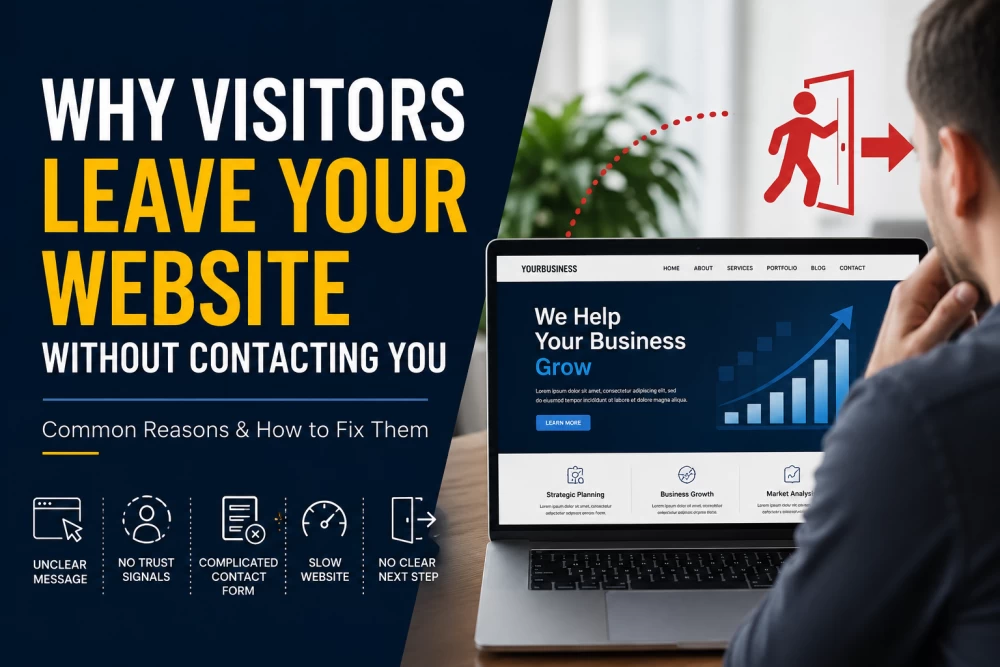
Table of Contents
- Your Website May Not Immediately Explain What You Do
- Your Website Talks Too Much About the Business
- Visitors Don't Know What to Do Next
- Your Contact Process Is Too Difficult
- Your Website Doesn't Build Enough Trust
- Your Portfolio Doesn't Explain the Results
- Your Website Looks Good on Desktop but Poor on Mobile
- Your Website Is Too Slow
- Your Website Looks Outdated
- Your Pricing Information Creates Confusion
- Your Website Doesn't Answer Customer Questions
- Your Website Doesn't Feel Personal
- Your Website Has Too Many Choices
- Your Call to Action Is Too Generic
- You Are Attracting the Wrong Visitors
- Your Website Doesn't Follow Up
- The Real Problem May Be the Gap Between Interest and Action
- A Simple Test for Your Own Website
- Turning Your Website Into a Lead-Generating Asset
- Final Thoughts
Getting people to visit your website is only the beginning. The real challenge starts when someone lands on your homepage, looks around for a few seconds, and leaves without calling, filling out a form, sending a WhatsApp message, or making a purchase.
This happens to businesses of all sizes. A website may have a modern design, professional photographs, detailed service descriptions, and strong search engine rankings, yet still generate very few enquiries.
The problem is often not traffic. The problem is what happens after the visitor arrives.
Your website has a limited amount of time to answer a visitor's questions, create confidence, explain your value, and make the next step obvious. If any of these elements are missing, visitors may simply move on to another website.
Understanding why this happens can help you turn an ordinary business website into a more effective lead-generation tool.
Your Website May Not Immediately Explain What You Do
One of the most common website problems is unclear messaging.
When someone visits your homepage, they should understand within a few seconds what your company does, who you serve, and why they should consider you.
Many businesses use headlines such as "Welcome to Our Website", "Innovative Solutions for a Better Future", or "Your Trusted Partner for Excellence."
These statements may sound professional, but they do not tell visitors enough.
Visitors Are Looking for an Immediate Answer
A potential customer is usually asking simple questions:
What does this company offer?
Is this service relevant to me?
Can this company solve my problem?
How can I contact them?
If the homepage makes visitors search for these answers, there is a good chance they will leave.
Instead of using a vague headline, a business should communicate its primary service clearly.
For example, a website development company could say that it builds business websites, eCommerce platforms, and custom web applications. A real estate company should make it immediately obvious that visitors can search properties or enquire about available properties.
Clarity should come before creativity.
Your Website Talks Too Much About the Business
Businesses naturally want to explain their history, achievements, technology, experience, and services. However, a potential customer is usually more interested in what the business can do for them.
A website that starts with several paragraphs about the company may fail to answer the visitor's most important question: "How does this help me?"
Change the Conversation From You to the Customer
Compare these two approaches.
"We are a leading company with years of experience and a dedicated team."
"We help local businesses build professional websites that generate enquiries and make it easier for customers to contact them."
The second statement focuses on the customer's problem and expected outcome.
Your experience still matters, but it should support your value proposition rather than replace it.
Visitors Don't Know What to Do Next
A surprisingly large number of websites provide information but don't provide direction.
A visitor reads the homepage, checks the services, perhaps looks at the portfolio, and then reaches the bottom of the page.
What happens next?
If the answer is "nothing", the website has missed an opportunity.
Every Important Page Needs a Clear Next Step
A website should guide visitors toward an action.
Depending on the business, that action could be:
Request a quotation
Book a consultation
Call the business
Send a WhatsApp enquiry
Schedule a meeting
Request a demo
Download a brochure
Purchase a product
The action should be visible without forcing visitors to search for it.
A strong call to action is not about aggressively asking for a sale. It is about making the next step easy.
Your Contact Process Is Too Difficult
Imagine a potential customer is interested in your service but your contact page asks for their name, email, phone number, company name, address, budget, industry, project description, and several other details.
Some visitors will simply leave.
Reduce Unnecessary Friction
Ask only for information that you genuinely need at the first stage.
A simple form containing name, phone number, email, and requirement may be enough to start a conversation.
You can collect additional information later.
The same principle applies to phone numbers and WhatsApp. If customers prefer messaging, forcing them to complete a complicated form can create unnecessary friction.
The easier you make the first conversation, the more likely visitors are to start it.
Your Website Doesn't Build Enough Trust
A visitor may be interested in your service but still hesitate because they don't know whether they can trust you.
This is particularly important for expensive services.
A customer considering a website project, software system, renovation project, professional service, or business consultation may be taking a significant financial risk.
Show Evidence Instead of Making Claims
Businesses often say:
"We provide the best service."
"We are highly experienced."
"We have thousands of satisfied customers."
Claims are easy to make. Evidence is much more persuasive.
Show real projects, customer testimonials, case studies, recognizable client types, certifications where relevant, years of experience, service locations, and clear business information.
A strong portfolio can often communicate more than a paragraph describing how good your company is.
Your Portfolio Doesn't Explain the Results
Showing screenshots of completed projects is useful, but simply displaying images may not be enough.
Visitors want to understand what you actually accomplished.
Turn Projects Into Case Studies
Instead of:
"ABC Company Website"
Explain:
"ABC Company needed a modern website to present its services and receive enquiries from mobile users. We redesigned the website, simplified the navigation, added enquiry forms, integrated WhatsApp, and improved the presentation of its services."
This gives potential customers a better idea of what working with you might look like.
Case studies also help visitors imagine how you could solve their own problems.
Your Website Looks Good on Desktop but Poor on Mobile
A visitor may discover your business through Google, Facebook, Instagram, or a WhatsApp link while using a smartphone.
If the website is difficult to use on a small screen, the visitor may leave before contacting you.
Mobile Experience Is Not Optional
A mobile-friendly website should have readable text, properly sized buttons, fast-loading images, simple navigation, and forms that are easy to complete with a thumb.
Important contact options should remain easy to find.
A website that technically "works" on mobile is not necessarily a website that provides a good mobile experience.
The question is not simply whether the page opens on a phone. The question is whether a visitor can comfortably understand the business and take action.
Your Website Is Too Slow
People are impatient online.
A visitor who clicks your website and waits for a large hero image, animation, advertising script, or complicated application to load may simply press the back button.
Speed Affects More Than Search Rankings
Website speed affects the user's perception of your business.
A slow website can make a company appear outdated, poorly maintained, or unreliable.
Common causes include oversized images, unnecessary plugins, poorly optimized code, excessive third-party scripts, weak hosting, and inefficient database queries.
Improving performance is therefore both a technical and a business decision.
Your Website Looks Outdated
Visitors may not consciously think, "This website uses an outdated design."
They simply feel that the business doesn't look trustworthy or current.
An outdated website can be particularly damaging when competitors have modern websites that are easier to navigate.
Design Should Support Confidence
A professional design does not necessarily mean complicated animations or expensive visual effects.
Good design usually means clear typography, logical spacing, consistent branding, useful images, simple navigation, and a strong visual hierarchy.
The objective is not to impress visitors with design tricks.
The objective is to make the business look credible while helping visitors find what they need.
Your Pricing Information Creates Confusion
Some businesses hide all pricing information because they believe customers should contact them first.
That can work for highly customized services, but it isn't always the best approach.
Give Visitors Enough Information to Qualify Themselves
You don't necessarily need to publish an exact price.
You could provide starting prices, packages, typical project ranges, or information about what affects the cost.
For example:
"Business websites start from..."
"Custom web applications are quoted based on features and complexity."
This helps visitors understand whether your service is likely to fit their budget.
It can also reduce enquiries from people who are completely outside your price range.
Your Website Doesn't Answer Customer Questions
Potential customers often have the same concerns before contacting a business.
How much does it cost?
How long will it take?
Do you work with businesses like mine?
What is included?
Do you provide support after delivery?
Can I update the website myself?
What happens after I submit an enquiry?
If your website doesn't answer these questions, visitors may search elsewhere.
Use FAQs to Remove Uncertainty
A well-written FAQ section can remove objections before they become barriers.
The best FAQs are based on real conversations with customers.
Your sales calls, WhatsApp messages, emails, and previous enquiries are excellent sources for discovering what potential customers actually want to know.
Your Website Doesn't Feel Personal
Many business websites look identical.
Stock photographs, generic slogans, corporate language, and anonymous team sections can make a business feel distant.
Show the People Behind the Business
Depending on the type of company, consider showing the team, founder, office, development process, or real project work.
For professional services, people often buy from people.
A potential customer may feel more comfortable contacting a business when they can see that there are real people responsible for the service.
Authenticity can be more persuasive than polished corporate language.
Your Website Has Too Many Choices
It may seem helpful to provide visitors with dozens of menu options, services, categories, buttons, banners, and links.
In reality, excessive choices can make decision-making harder.
Simplify the User Journey
Think about the three or four actions that matter most to your business.
For example:
View Services
See Our Work
Request a Quote
Contact Us
Other information can still exist, but it doesn't need to compete equally for attention.
A focused website usually produces a clearer customer journey.
Your Call to Action Is Too Generic
"Submit" is not an inspiring call to action.
"Click Here" doesn't explain what happens next.
"Contact Us" is acceptable, but it can often be improved.
Make the Action Specific
Consider phrases such as:
Request a Free Consultation
Get a Project Estimate
Discuss Your Website
Request a Demo
Talk to Our Team
Start Your Project
The best CTA depends on the visitor's stage in the buying process.
Someone researching a service may prefer "Book a Consultation", while someone who already understands what they need may respond better to "Request a Quote."
You Are Attracting the Wrong Visitors
Sometimes the website isn't the problem.
The marketing campaign may be attracting people who were never likely to become customers.
For example, an advertisement promising extremely cheap website development may generate many enquiries from people looking for the lowest possible price. If your actual service is positioned as a professional business solution, these leads may not be suitable.
Match Your Marketing With Your Website
Your advertising message, landing page, pricing, service offering, and sales process should all tell a consistent story.
Good marketing isn't simply about getting more visitors.
It is about getting the right visitors.
Your Website Doesn't Follow Up
A visitor may be interested but not ready to contact you immediately.
They may be comparing three companies, discussing the project internally, or waiting for a budget.
If the website gives them no reason to return, the opportunity may disappear.
Give Visitors a Reason to Stay Connected
Depending on your business, you can use useful resources, newsletters, consultation offers, downloadable guides, remarketing, social media, or other appropriate follow-up methods.
The goal is to remain available when the visitor becomes ready to make a decision.
The Real Problem May Be the Gap Between Interest and Action
Most website visitors don't arrive ready to buy immediately.
There is usually a journey:
They discover the business.
They investigate the service.
They compare alternatives.
They evaluate trust.
They consider cost.
They look for evidence.
They decide whether contacting the business is worth their time.
Your website should support that journey.
If it only says, "Buy from us," it may fail to address everything that happens before the buying decision.
A Simple Test for Your Own Website
Open your website as if you were a completely new customer.
Don't use your knowledge of the business.
Give yourself five seconds on the homepage.
Then ask:
What does this company do?
Who is it for?
What problem does it solve?
Why should I trust it?
What should I do next?
Can I contact the company easily from my phone?
Can I understand the services without asking someone?
Can I find examples of previous work?
Can I understand approximately what the service may cost?
If you struggle to answer several of these questions, your visitors may be struggling too.
Turning Your Website Into a Lead-Generating Asset
A successful business website isn't simply an online brochure.
It should work as part of your sales and marketing system.
Your website should attract the right visitors, explain your value, build trust, answer common questions, remove objections, and make contacting your business easy.
Start With the Biggest Problems
You don't necessarily need to redesign everything immediately.
Start by identifying the biggest barriers.
Improve your homepage message.
Make your primary call to action obvious.
Add real customer evidence.
Improve mobile usability.
Simplify your contact form.
Improve page speed.
Create useful service pages.
Add relevant case studies.
Answer common customer questions.
Then measure what happens.
Look at website enquiries, phone calls, WhatsApp conversations, form submissions, engagement, and the pages visitors use before contacting you.
Final Thoughts
A visitor leaving your website without contacting you doesn't automatically mean your website has failed.
Some visitors are only researching. Some are comparing competitors. Some are not ready to buy.
However, if hundreds or thousands of relevant visitors arrive every month and very few take the next step, there is probably a problem worth investigating.
The answer may be unclear messaging, weak trust signals, poor mobile usability, slow loading, confusing navigation, complicated forms, missing information, or simply a lack of a clear reason to contact you.
The most effective websites don't force visitors to become customers.
They make the decision easier.
Your website should quickly explain what you do, demonstrate why you're credible, answer the questions customers are already asking, and provide a simple path toward starting a conversation.
Because ultimately, the purpose of a business website isn't just to be visited.
It is to help the right visitor take the right next step.